How do we do it?
Get insight into the secret of bell production. On the trail of an old craft.
You can find out the exciting production in the video and in the photo gallery. Come with us and experience an ancient tradition from Switzerland.
The molding sand – a family secret
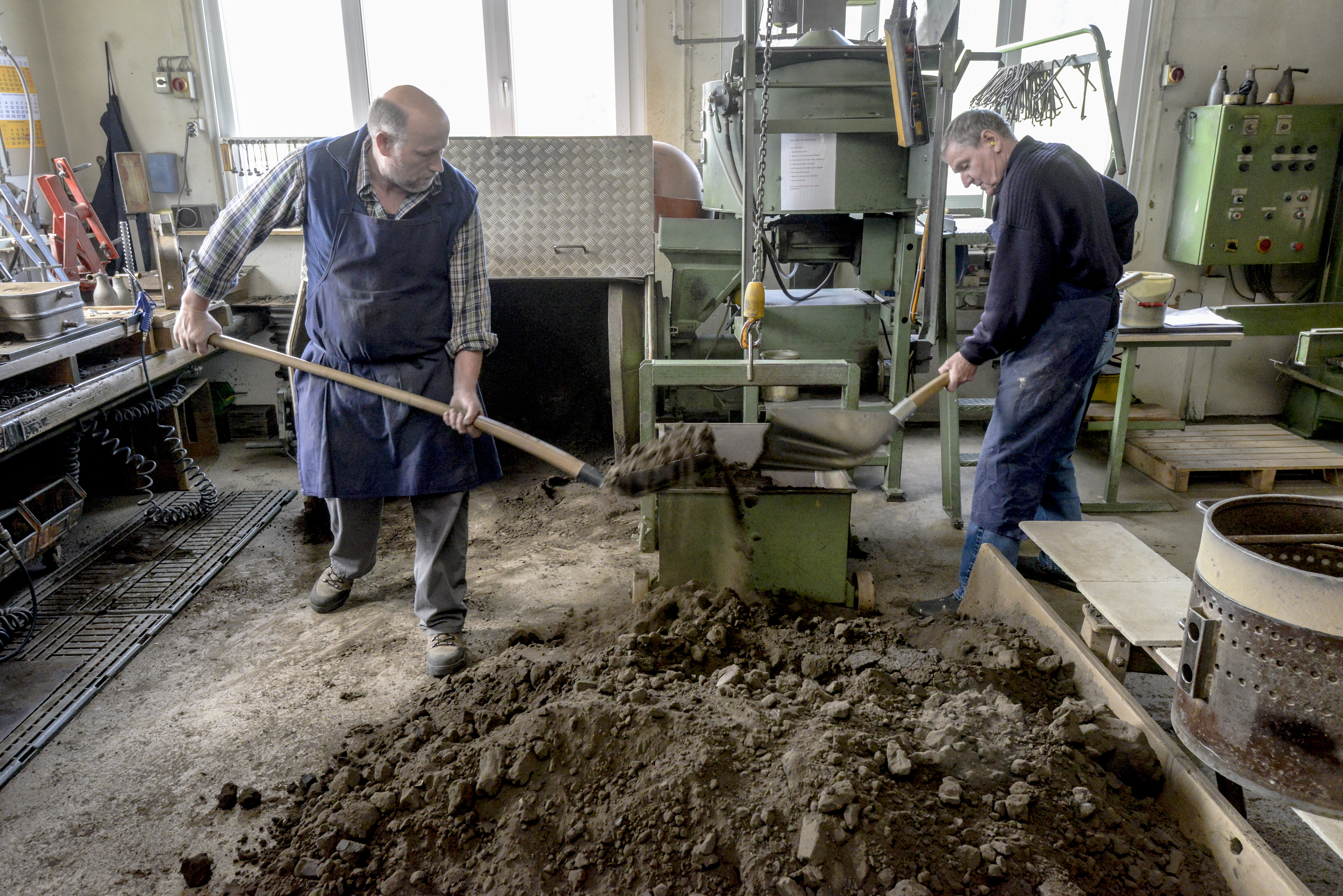
Only the best raw materials are good enough for genuine Swiss cowbells. The required materials are carefully selected. The molding sand needs special properties to withstand the 2,000.0°F. The sand is also important for the beautiful surface of the bell. The surface can only succeed with a perfect sand mixture. The sand recipe is well guarded and passed down orally to family members for generations.
The molding sand is a yellow natural sand consisting of approx. 20% clay. This is moistened with approx. 5% water. After each pour, the now black sand is reprocessed and used again. Who knows, maybe there will be a grain of sand that is hundreds of years old.
The alloy of the genuine Swiss bells
Bronze – The queen of all metal alloys. Only genuine bell bronze makes a cowbell ring.
Of course, only bronze from a certified recycling plant is used. This is the only way to guarantee that the metal is free of harmful substances and can withstand the high quality requirements.
Imagine if your bell uses scrap or scrap metal that has not been professionally refurbished. The bell could lose its sound forever, or worse, contain lead, arsenic, or other toxins. Well, scrap becomes scrap.
The steel mold, moulding sand and the master model
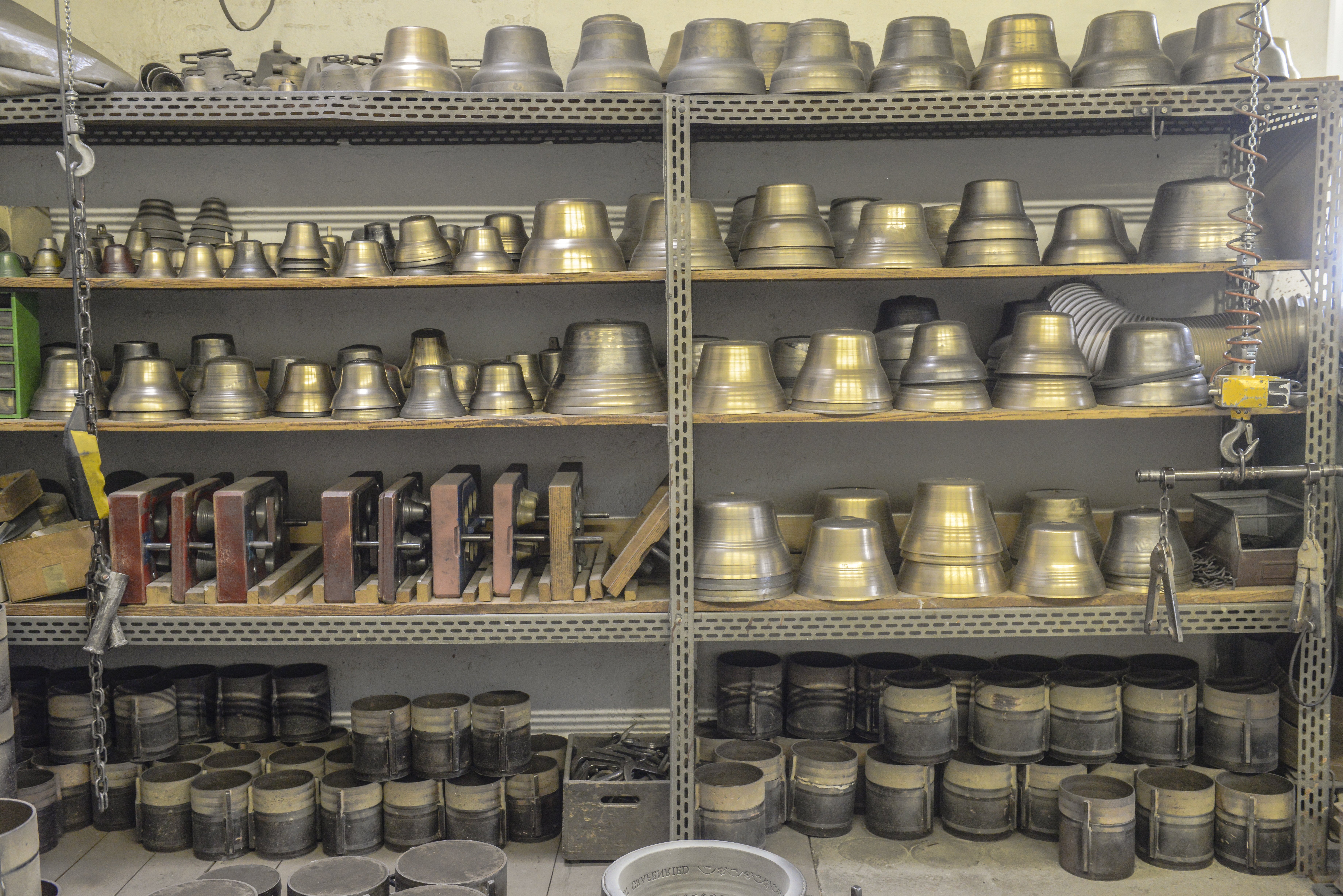
To craft a bell, you need a steel mold, a bell model, and sand. Some of the bell models are over 100 years old. Living history!
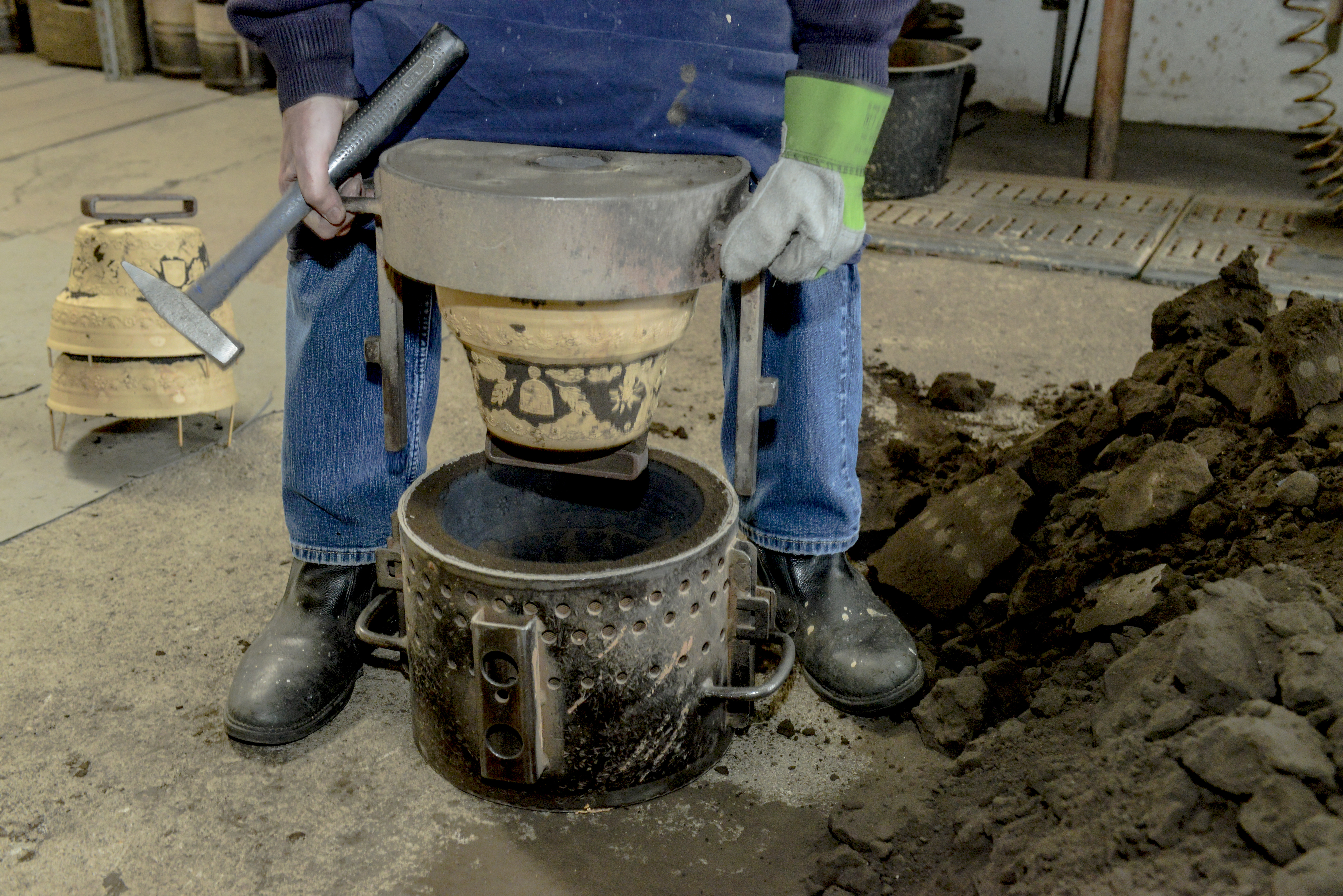
The bell model is placed in the steel mold. The steel mold holds the sand together.
The outer shape of the Swiss bell
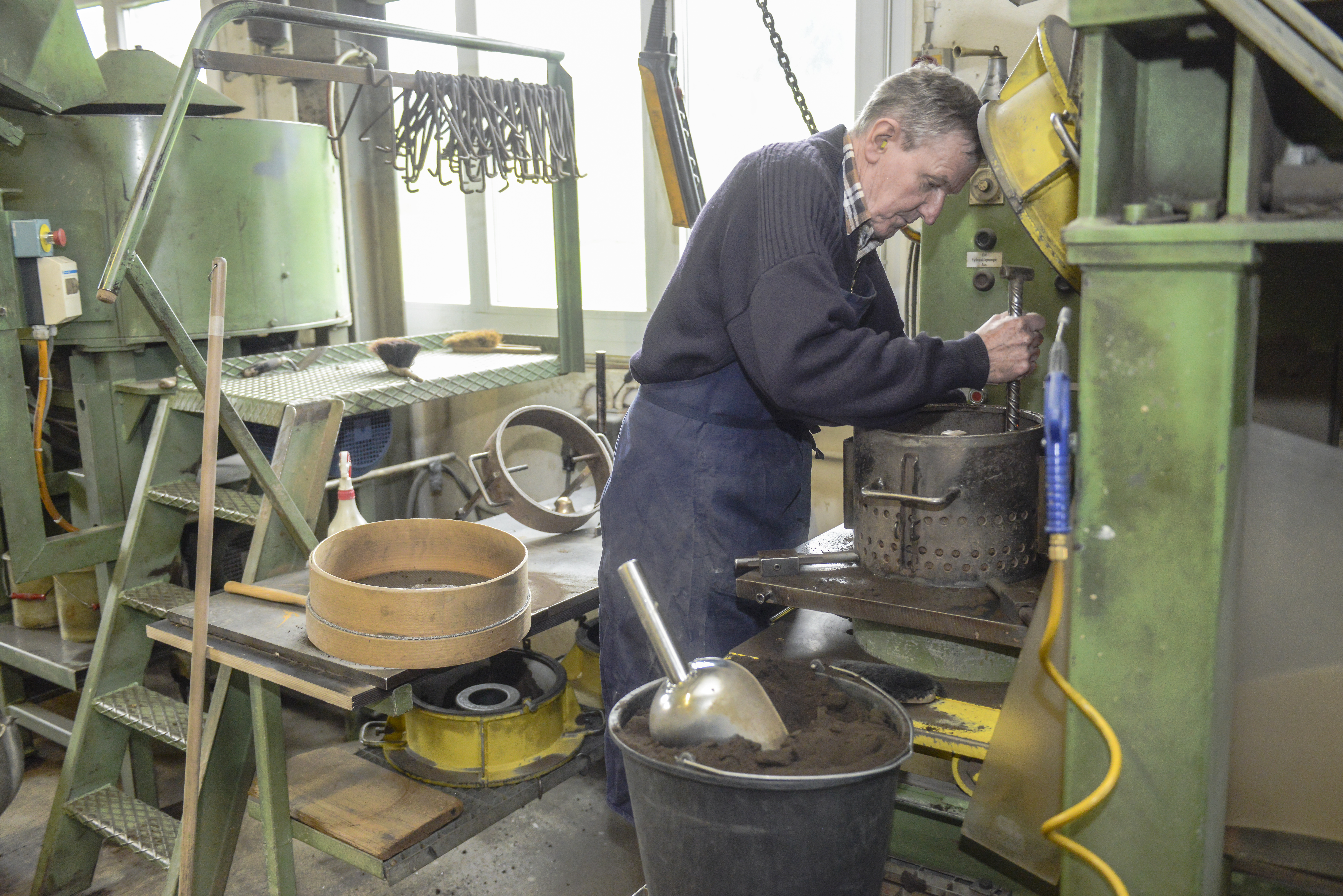
The bell model is painted with graphite and placed in the center of the steel mold. The space between the model and the steel mold is now filled with stand. The sand is compacted with a tamper. This is how the outer shape is created. At the same time, the strap mount is molded into the model and centered.
The inner shape of the bell
Let’s go! The inner form is made.
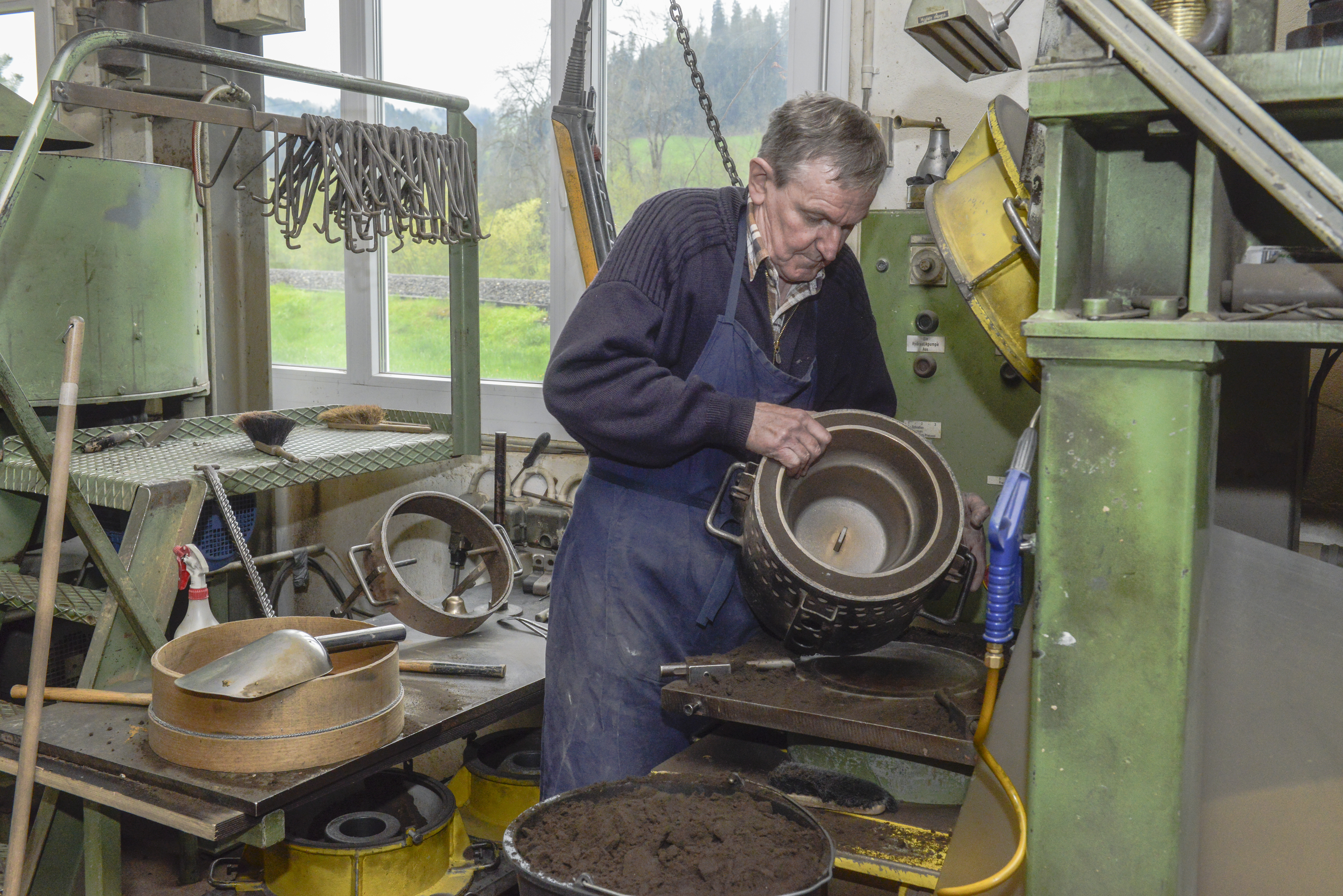
First the heavy form is turned over. Now the second part of the molding box is placed on the steel mould. To prevent the sand from collapsing, we use iron reinforcement. This is very important as the bell for the casting is upside down. Without reinforcement, the core would break off.
Now the bell model is completely embedded in the sand. But how does the bronze get through the sand? Come along, that will be shown in the next step!
The pouring channels for the alloy
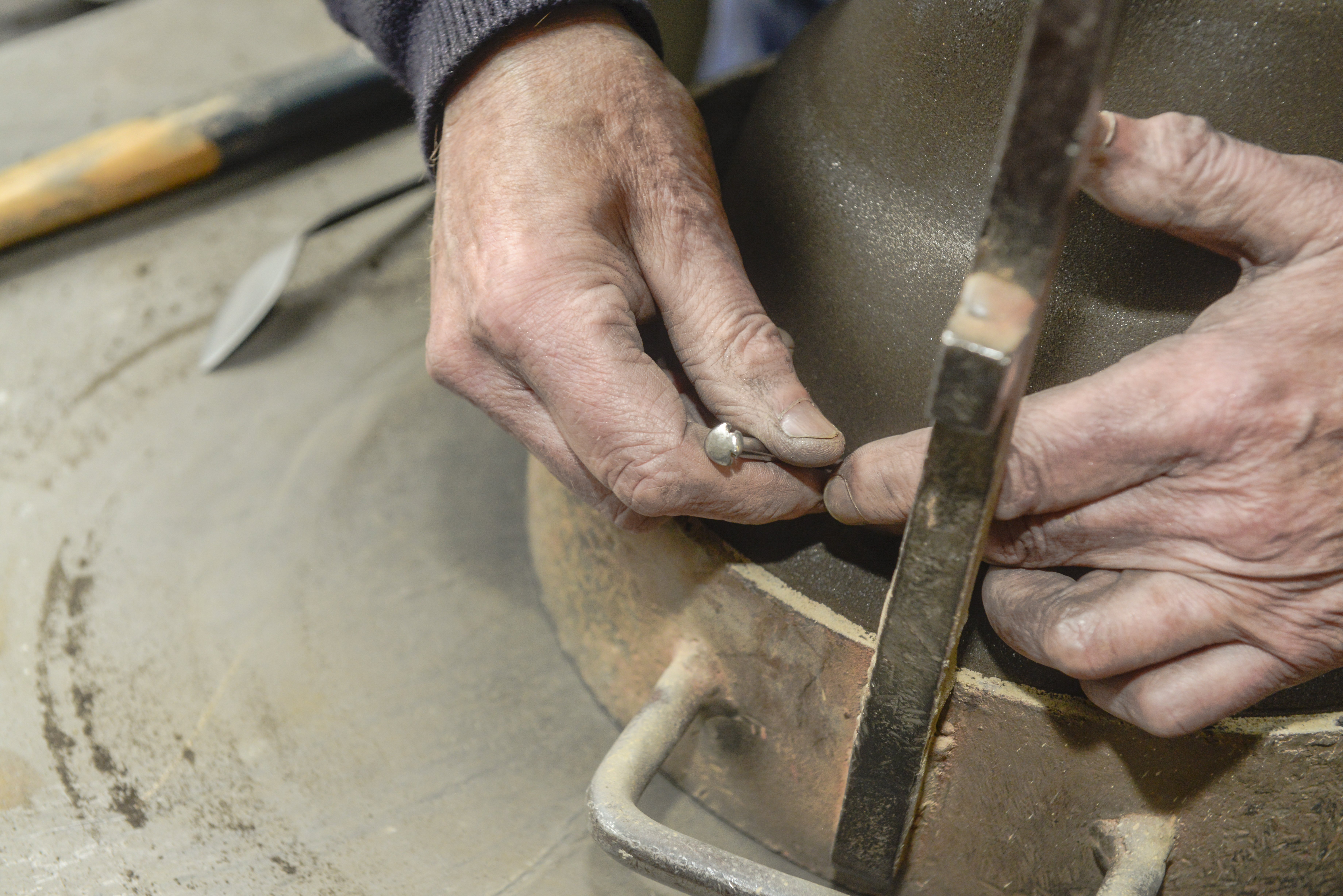
The bronze must get inside the mold. For this purpose, the casting channels are cut into the sand mold with a lot of skill and even more experience. Watch out! Too few channels and the bell bronze does not flow everywhere. If the ventilation channels are missing, then the bell has holes. If the channels are too far down, then the bronze will not flow, too far up, then the bronze will not come to the bell. It’s very challenging!
Open the mould
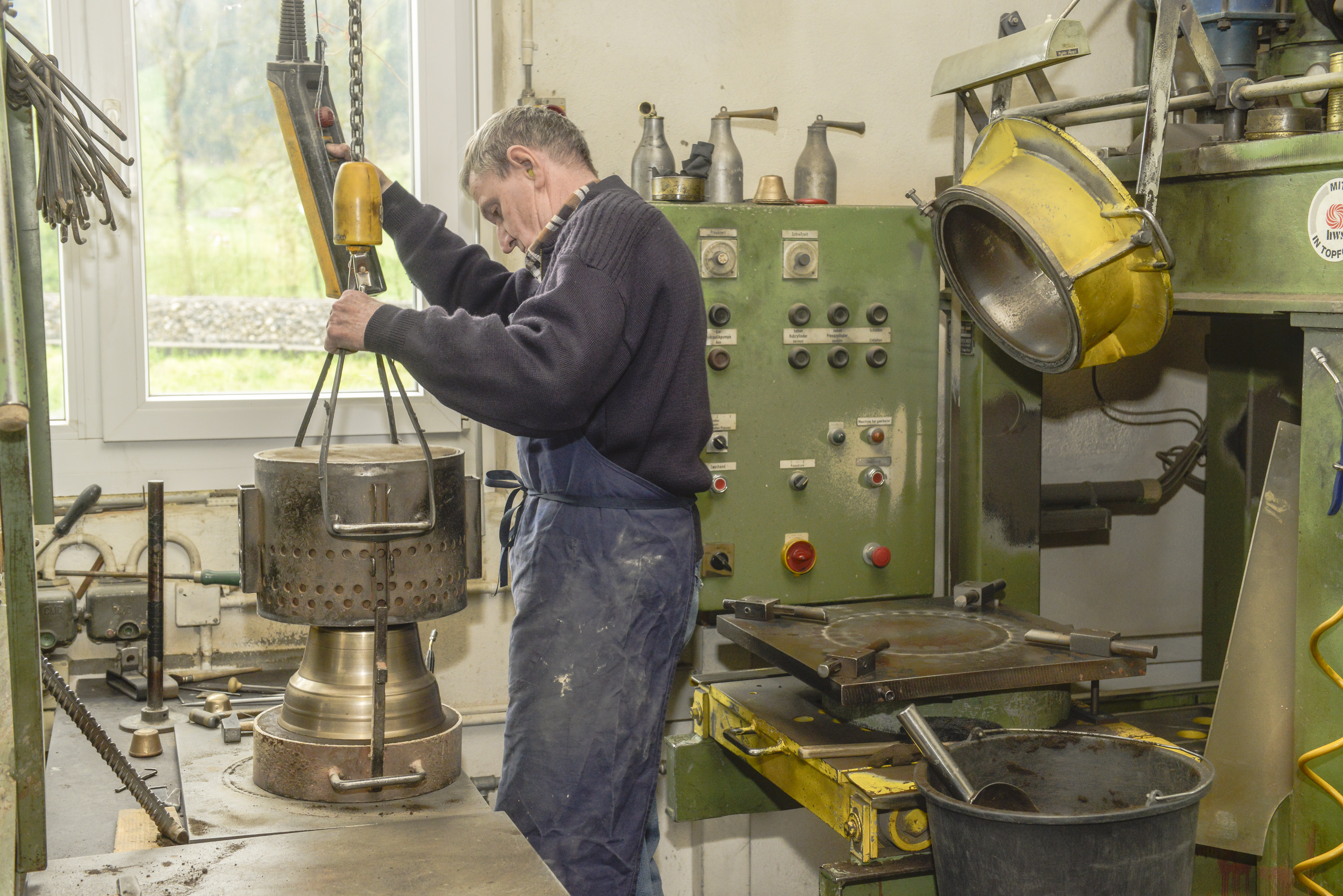
Now the bell model needs to be removed. To do this, we open the steel mold and remove the model. Now the bell is ready to be embellished and decorated.
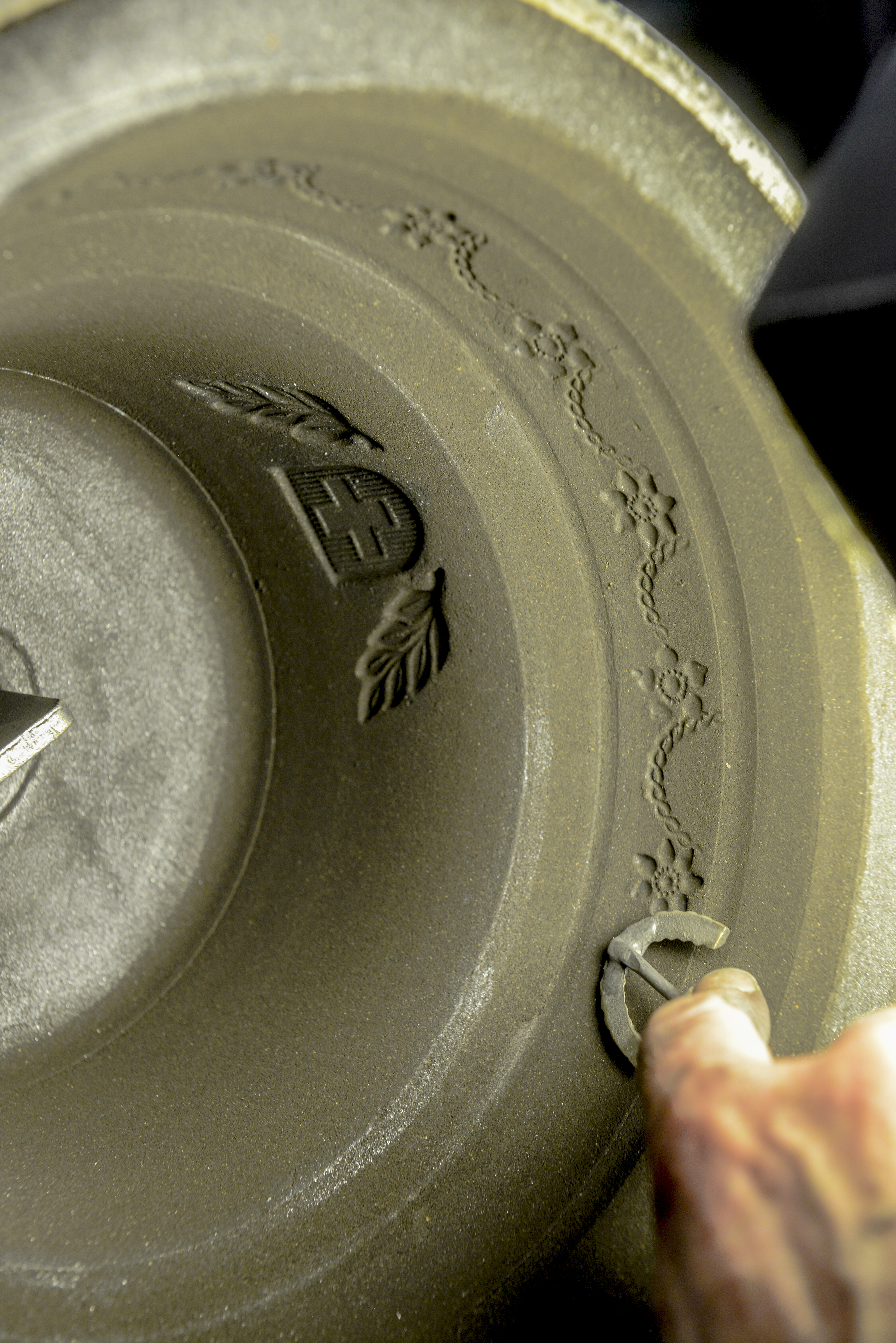
Labeling and decorating by hand
The bell is now decorated by hand. More than 2,500 different flowers, animals, ornaments, stamps and embellishments are used for the richly decorated bells. Some are even over 200 years old and are used every day.
A very special craftsmanship. Only the most skillful and talented craftsmen can decorate such a bell.
The sand mold needs to dry
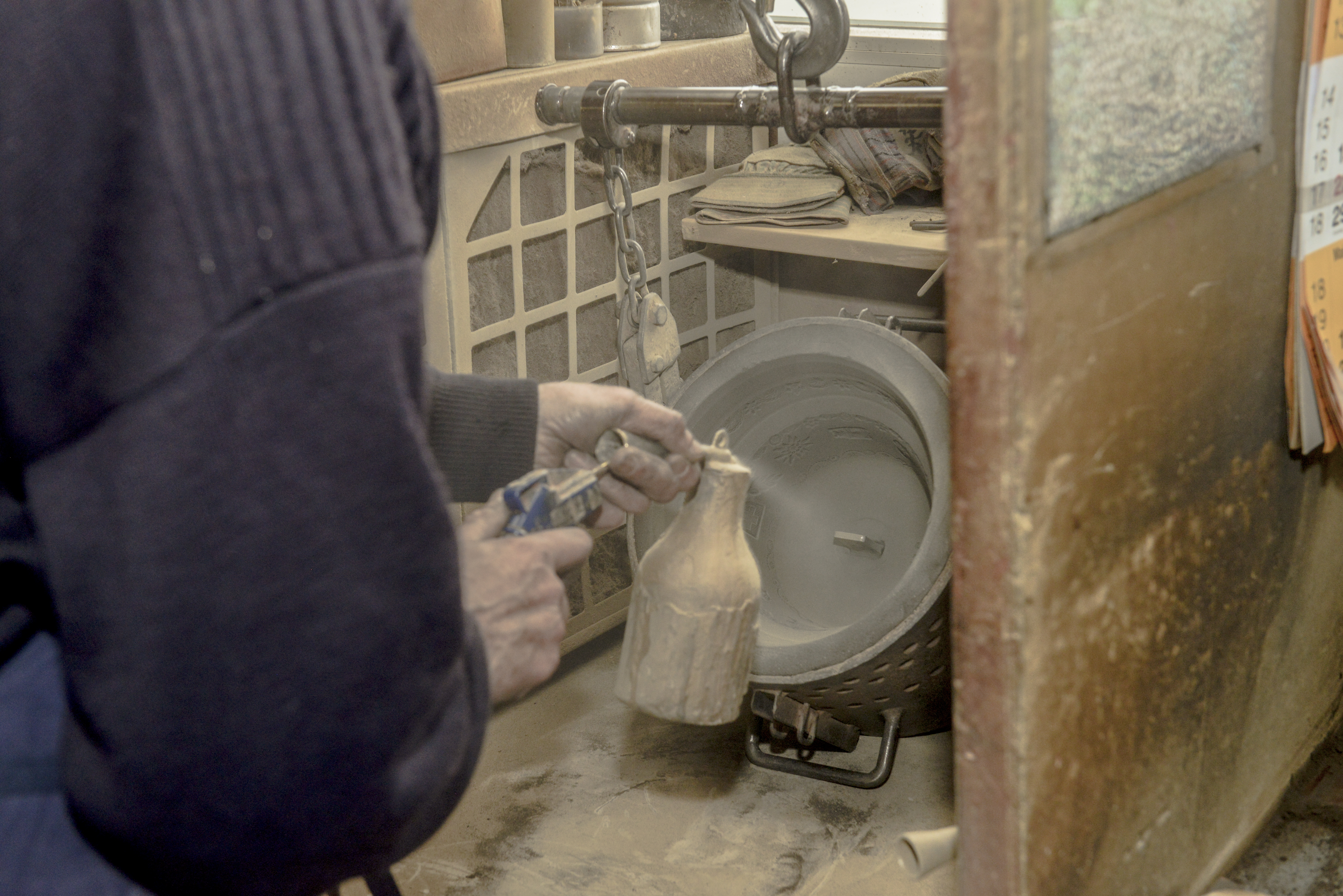
The sand is enclosed with a varnish. So the sand can no longer collapse.
Now the paint has to dry. No water should remain on the form. When water and 2’000.0°F hot bronze come together during casting, a highly explosive gas is produced. This can cause serious damage to people and material. The strength is to be found in serenity.
The wedding of the shape
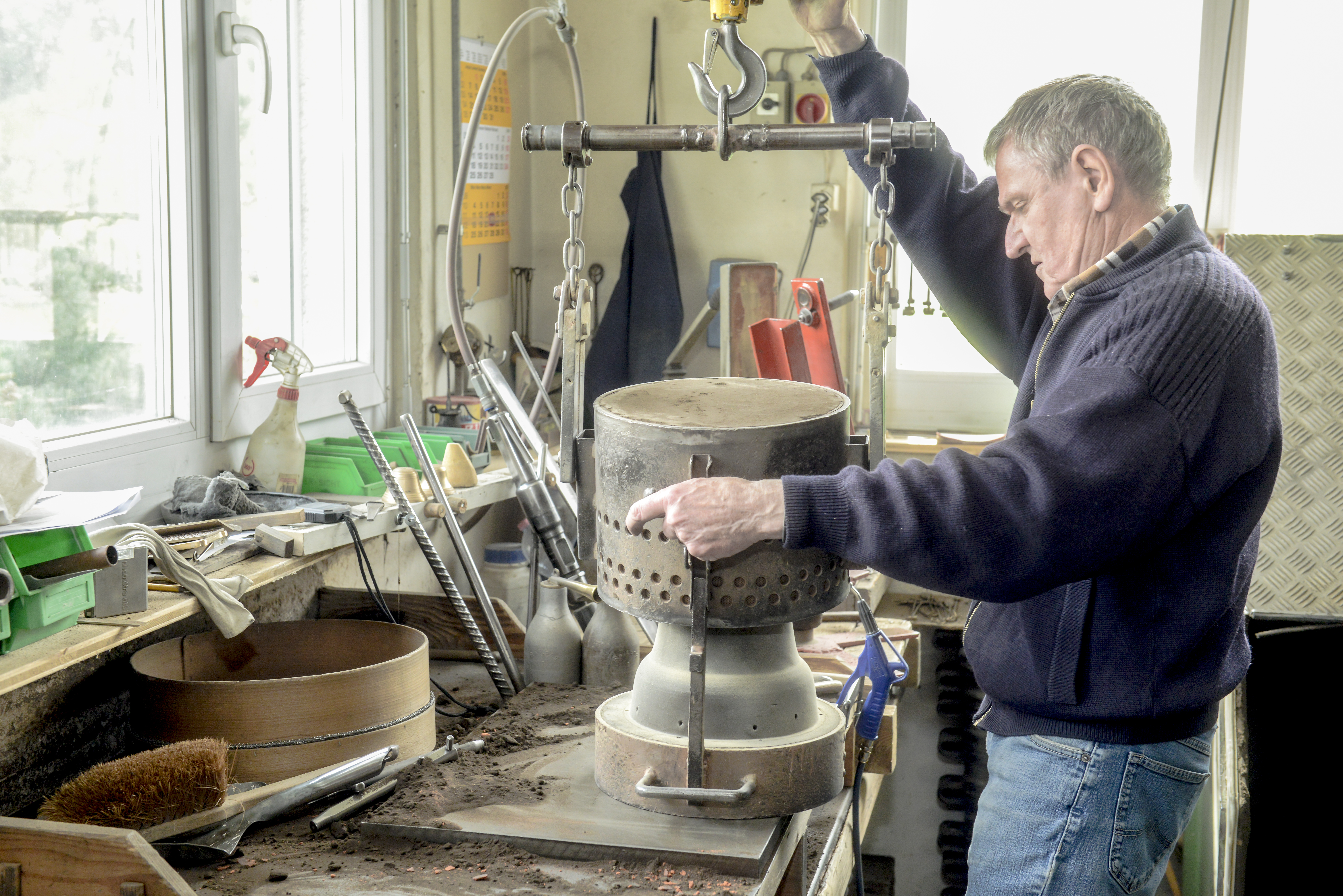
It’s time. The marriage takes place, the final union of the two parts. The sand mold is closed with iron clamps so that it can withstand the enormous casting forces. The bell molds are transported to the casting line and fixed there.
Prepare for casting
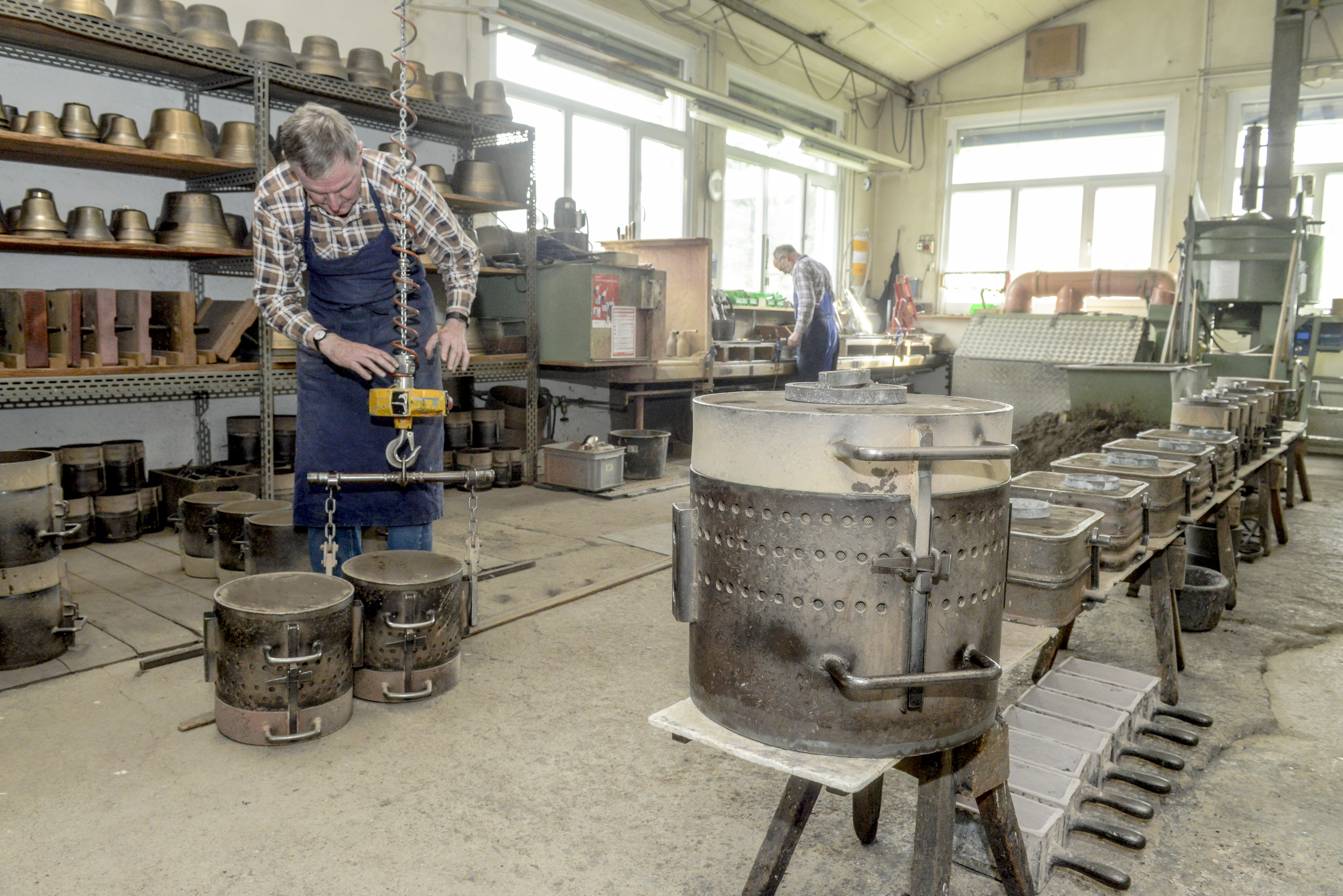
More and more bell shapes are ready. Imagine: At the moment «nothing» is in the form. Something completely new will soon be created.
A new cowbell
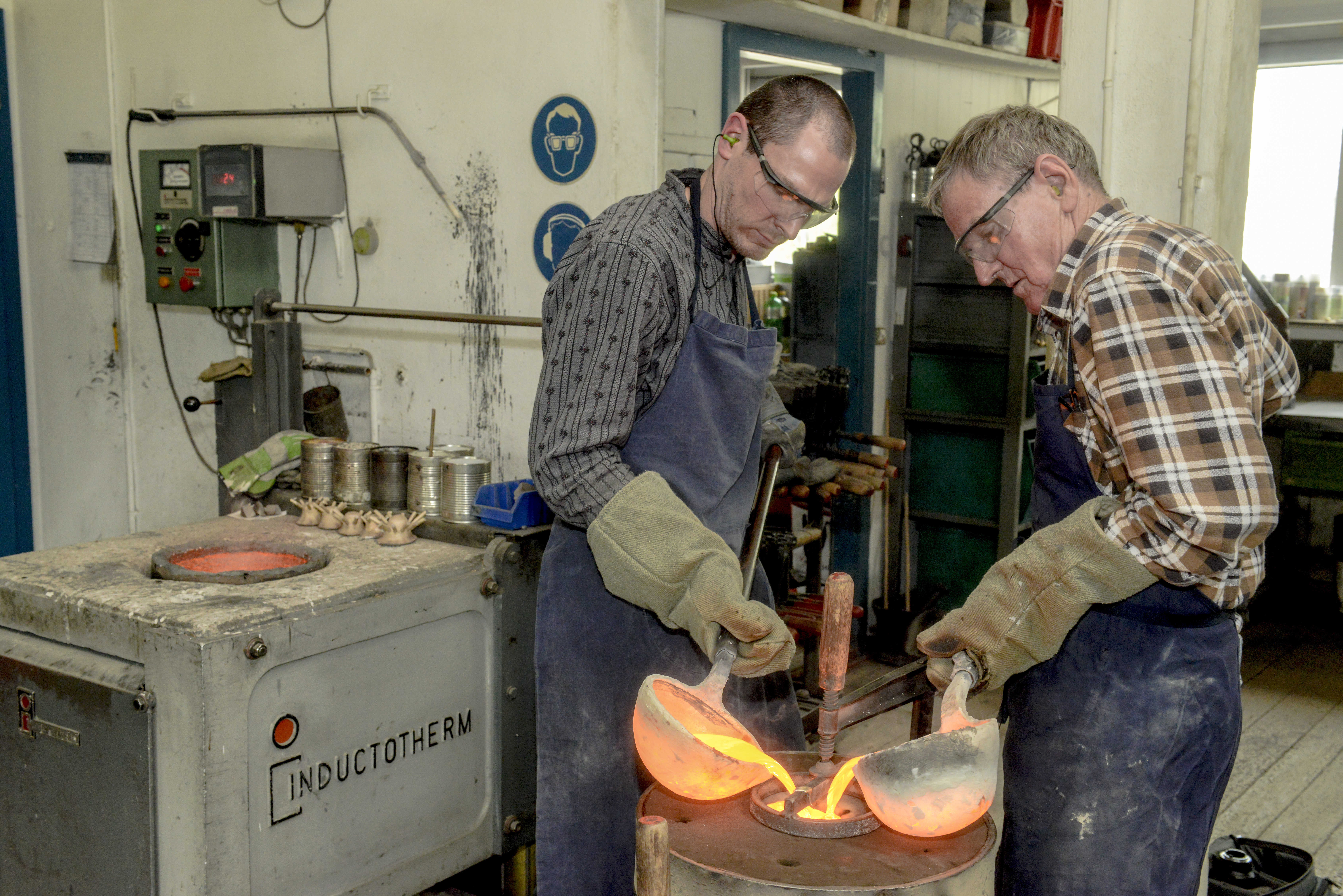
“Good luck for!”. The casting of the real Swiss cowbell begins with the traditional foundry greeting.
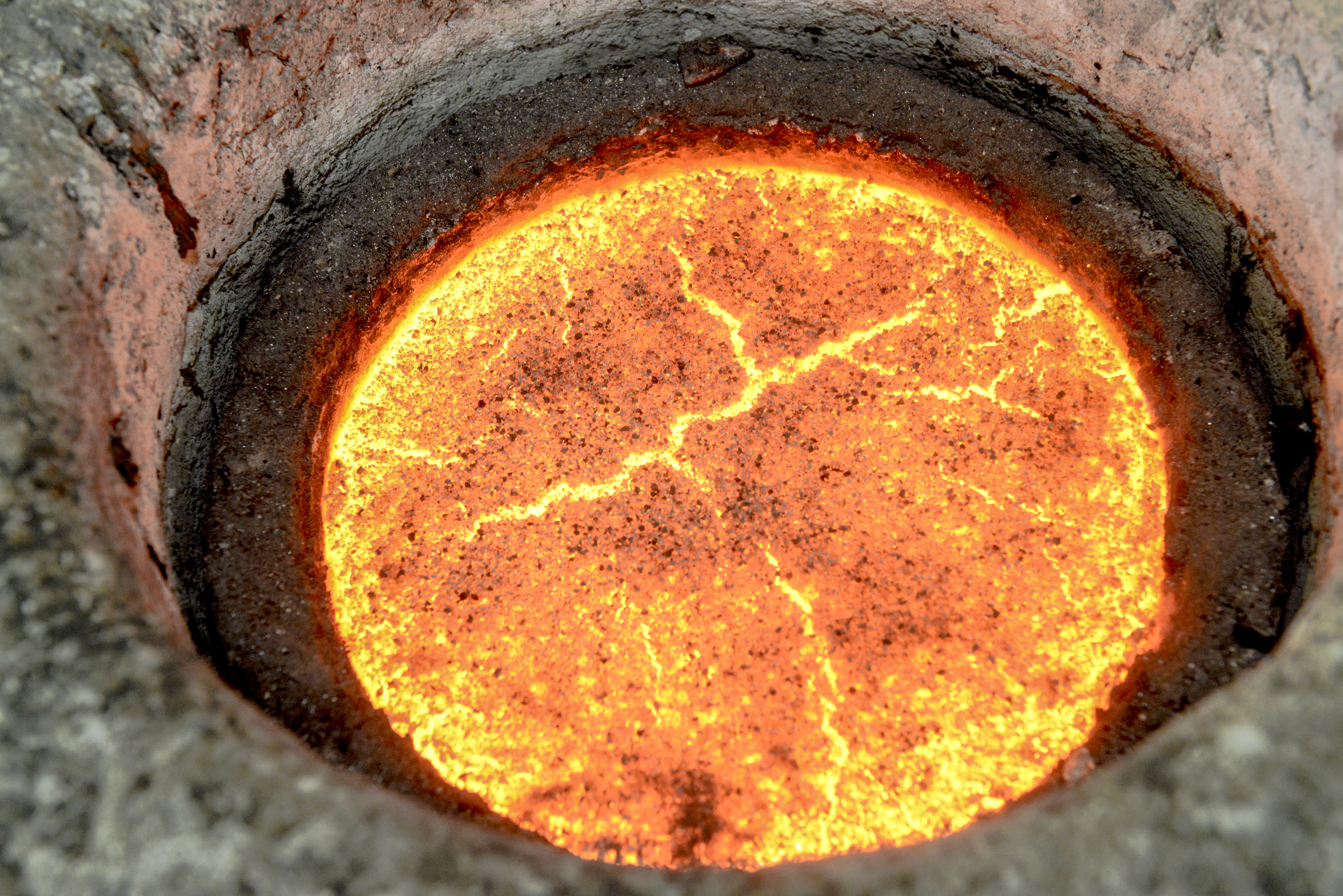
2’200.0°F hot bronze is a highlight every day. At this moment the four elements come into play: earth, fire, water and earth.
A simulation of a bell cast
This is what it looks like inside the sand mold during casting.
Cooling down
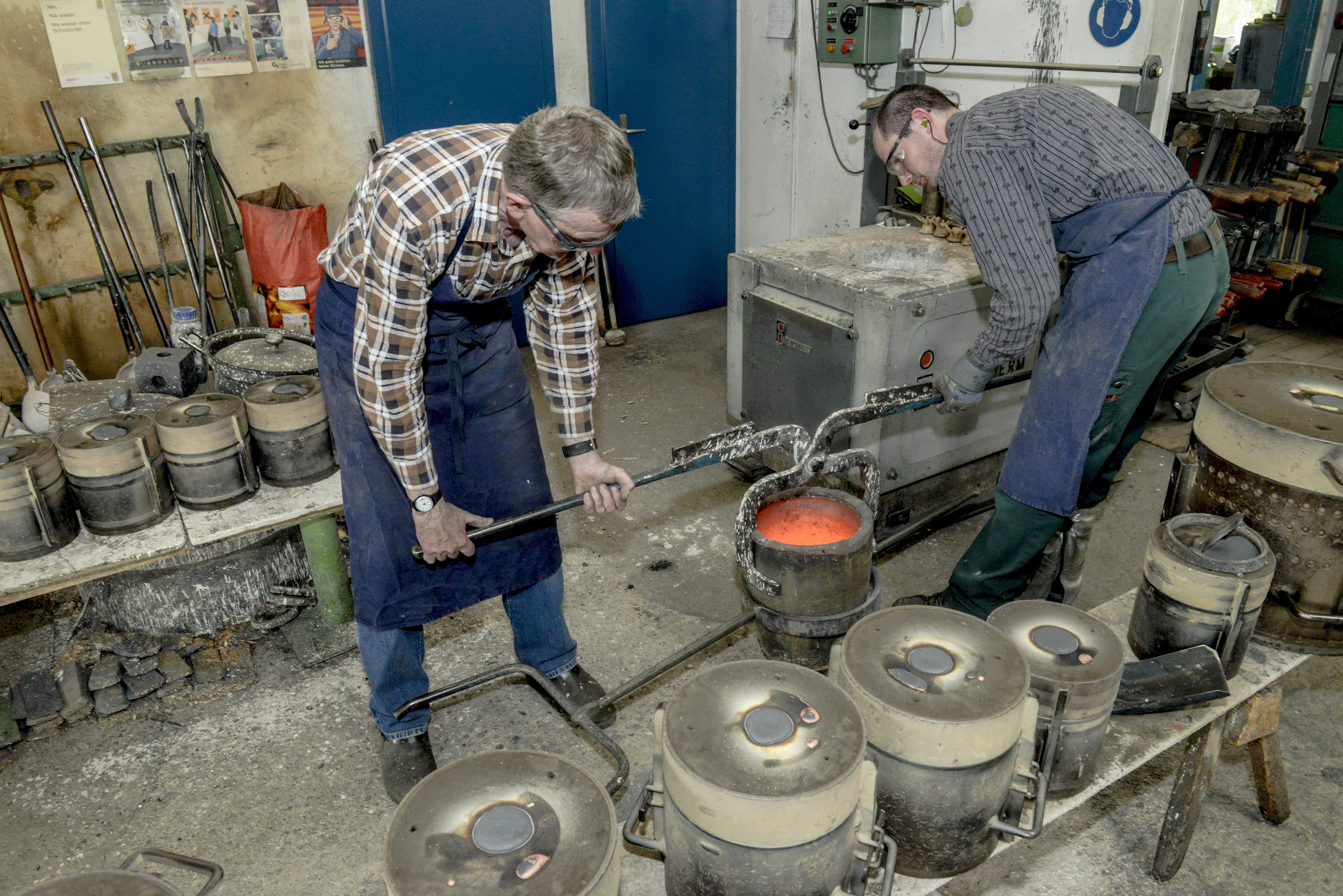
The forms must now rest. The next day you can see whether the casting was successful. Even after 290 years, something can always go wrong. Bell casting is a craft and remains exciting every day.
The birth of a new cowbell
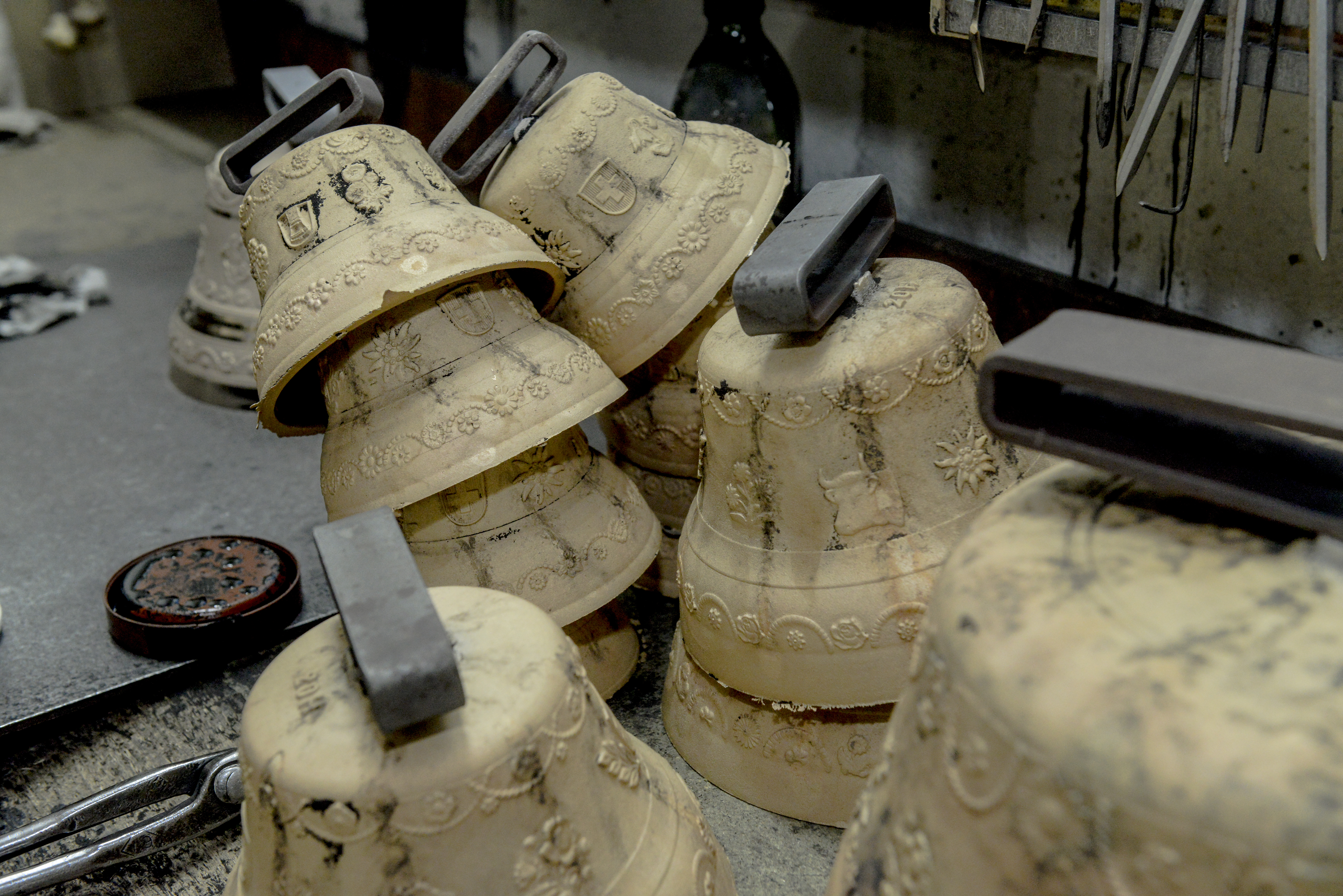
The bell is born! Did the casting succeed? Does the bell meet the quality requirements? The master scrutinizes every single cowbell with a strict look.
After birth, the bells are roughly cleaned of sand. The sprues and air pipes are knocked off and melted down again.
After the casting
Now the bells are ground and the edges are broken. Unevennesses are sanded and plastered.
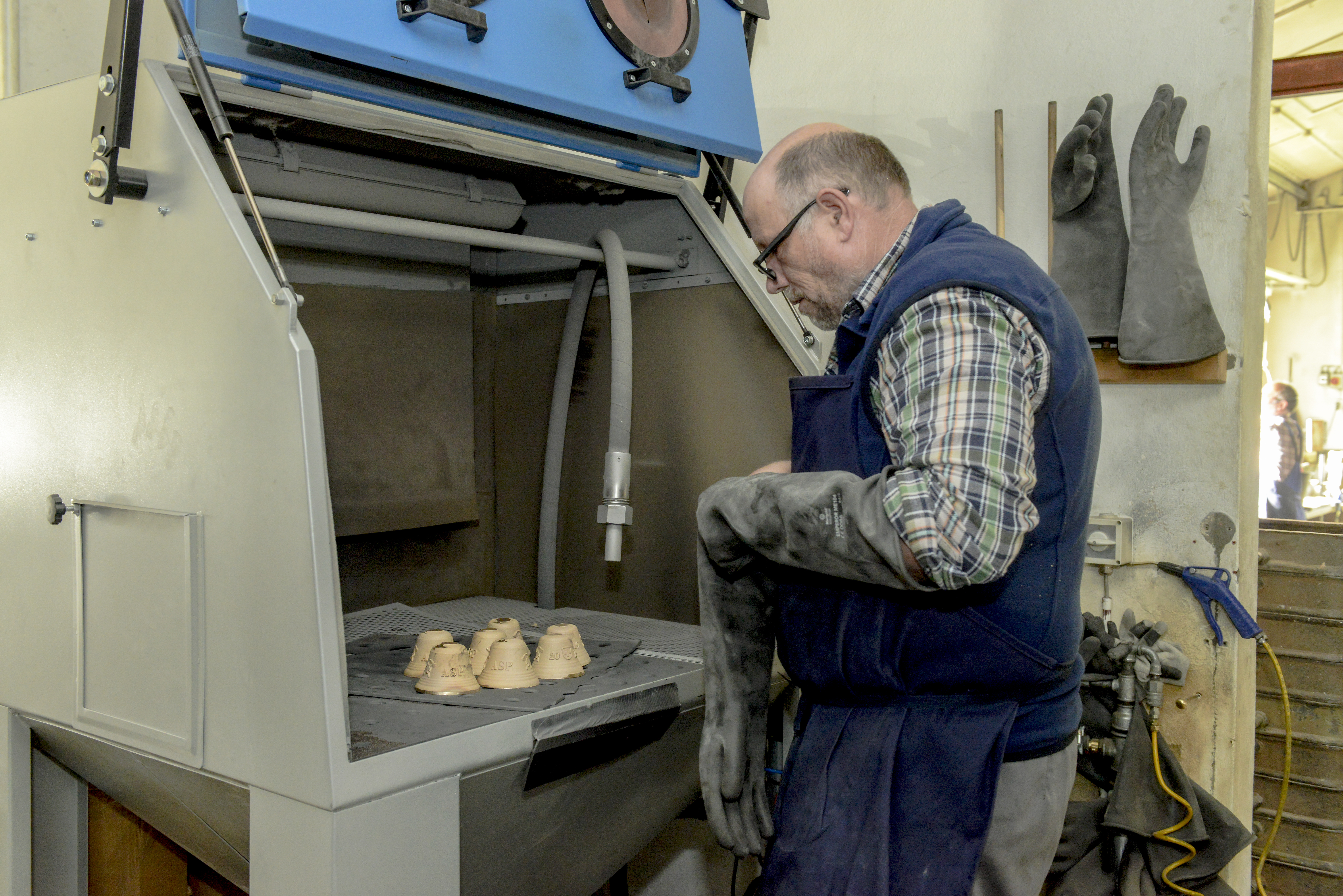
Sandblasting
Now the bells are sandblasted. This is where the bell gets its beautiful surface. The exact composition of the sandblasting components is also a little secret. Only with the right components does the bell become a beauty.
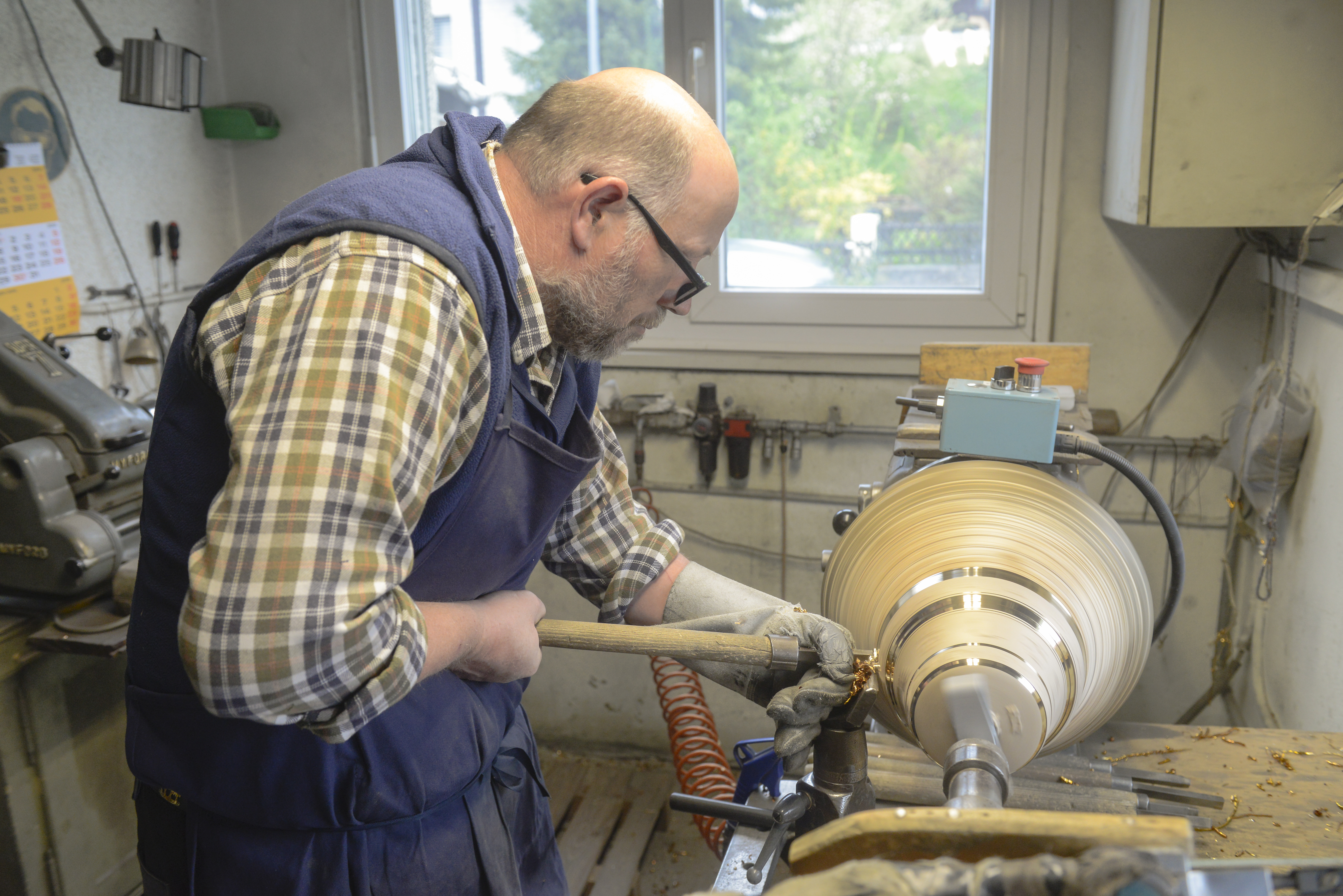
The lathe
The coat of arms is ground before turning. The strips are made entirely by hand. The lathe operator sees the finished bell in front of him before he begins. It takes a great deal of skill and experience to give the bell its famous stripes. Needless to say, only the most experienced craftsmen can work here either.
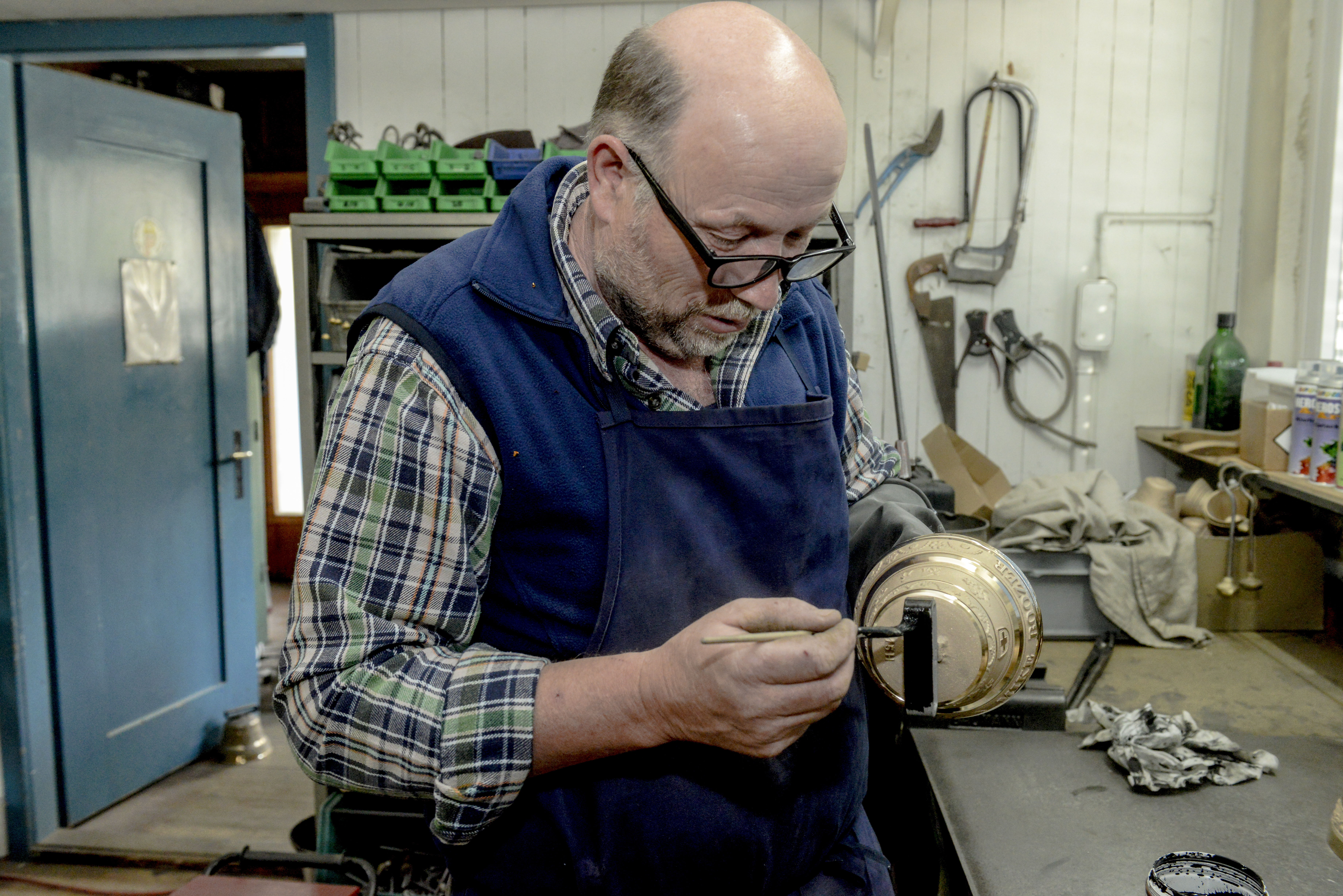
The final check
The bell sling swivel is now provided with a protective paint so that it does not rust. The clapper is then complained about.
The big moment: For the first time in the life of a bell, its sound echoes through the production facility. What a fantastic moment!
By the way: the sound of a bell means protection and luck. Just beautiful!
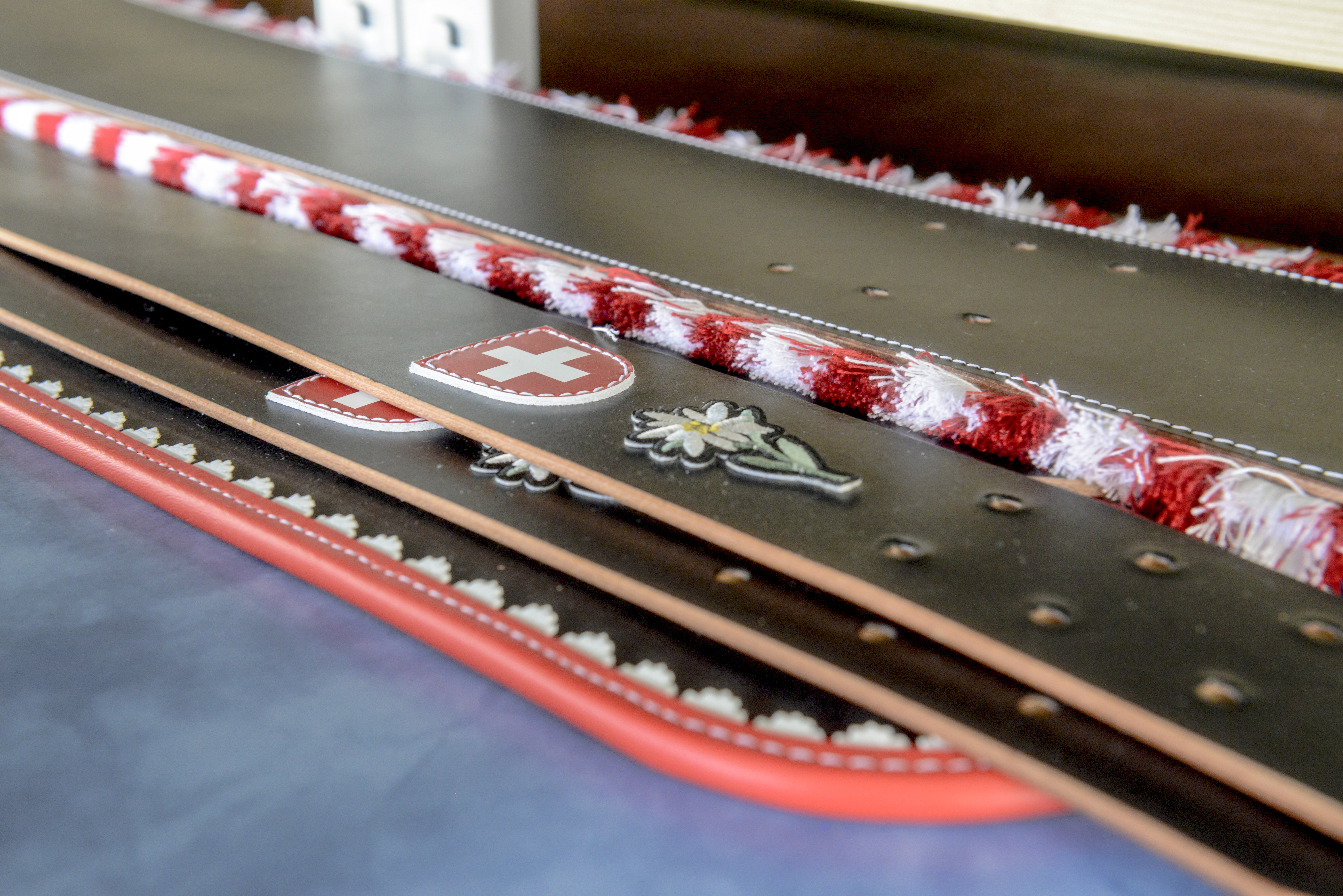
The strap for the cowbell
What makes a bell a cowbell? That’s right, the bell band!
These are also made in the in-house saddlery. Of course, everything here is cut, sewn and glued by hand.
Get togehter
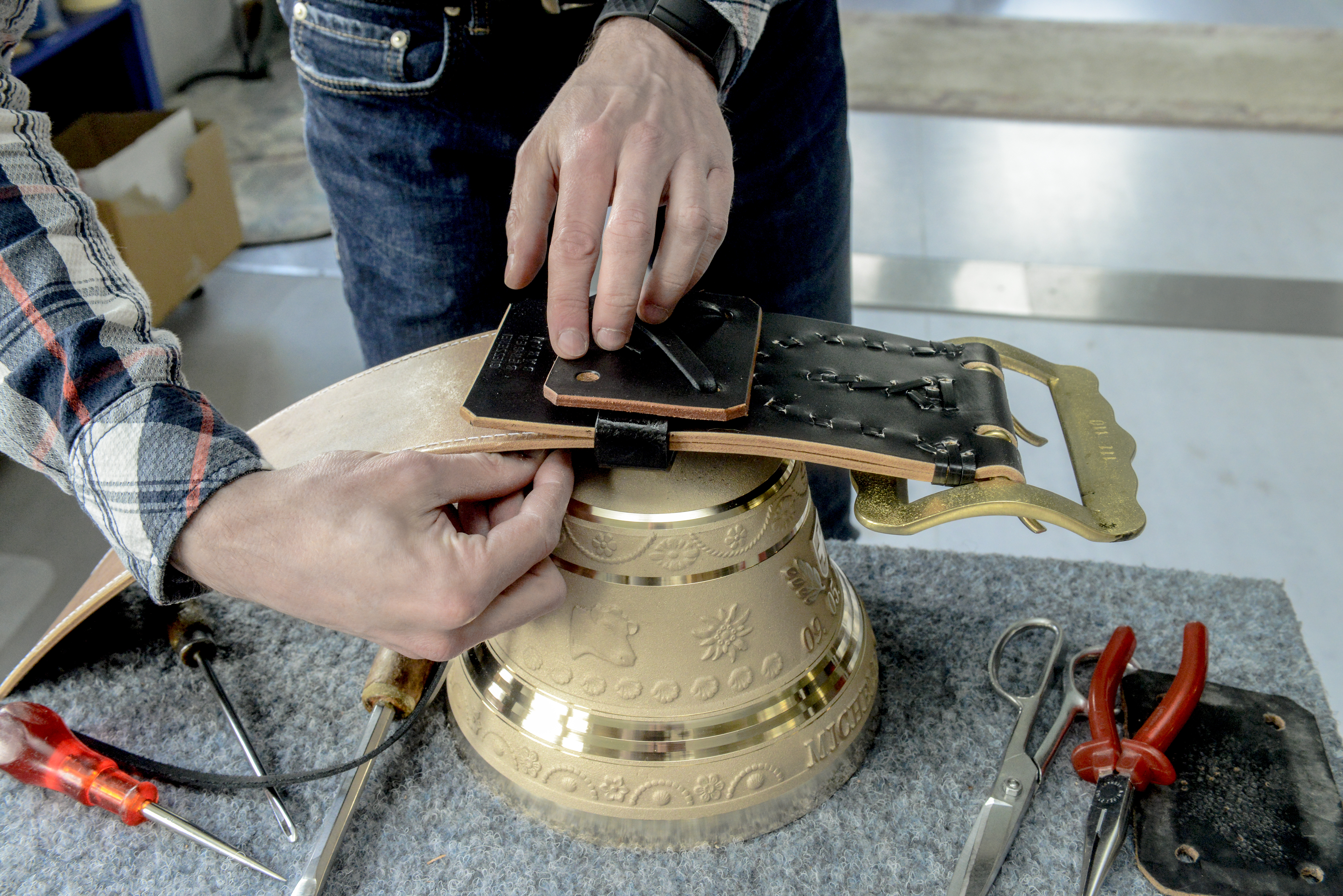
Handmade to the end. The bell is attached to the bell strap with a leather strap.
Now the bell is complete. Find a nice spot so that this unique piece of traditional craftsmanship is seen by all.